
An assault charge can put your freedom, your job and your family life on hold overnight. Provident Law LLP defends clients charged with assault in Mississauga, Brampton and across the GTA. A partner reviews your case from the first call, and we start building your defence before your first court date.





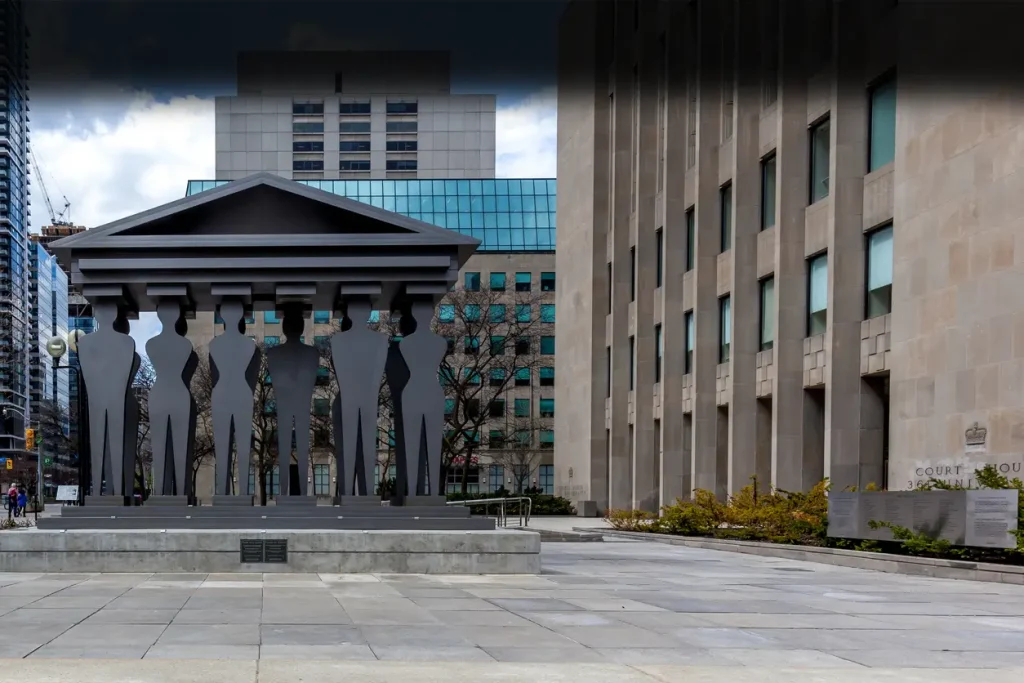
Most assault charges laid in Mississauga are heard at the A. Grenville & William Davis Courthouse in Brampton. Our partners appear there regularly and know how assault files move through the Ontario Court of Justice, from the first appearance and Crown screening to judicial pre-trials and trial.
As assault defence lawyers, we focus on the evidence the Crown actually has. We review the police notes, 911 recordings, body-worn camera footage, witness statements and medical records line by line. If there is a self-defence argument, a credibility problem or a Charter breach, we find it early and use it to push for the strongest available result.
Under section 265 of the Criminal Code, assault includes intentionally applying force to someone without their consent, or attempting or threatening to apply force. No injury is required. The specific charge depends on what is alleged.
Call us. A partner will tell you honestly whether we can help at your court location.
The most common assault charge, often laid after a push, a grab or a fight with little or no injury. Many first-time cases can be resolved without a criminal record.
Alleged where the injury is more than brief or minor. We test the medical evidence and whether the accused actually caused the injury.
Covers using, carrying or threatening to use a weapon or an imitation. “Weapon” can include everyday objects, so how the item was used is often the key issue.
Treated as seriously as assault with a weapon. Since July 15, 2026, these allegations also carry a reverse onus at bail, which makes early legal help essential.
The most serious assault charge, alleged where someone is wounded, maimed, disfigured or their life is endangered. These cases need a full defence strategy from day one.
Charges that often follow an arrest or a confrontation with police. The lawfulness of the officer’s conduct is frequently central to the defence.
Assault charges involving a partner or family member come with no-contact orders and a separate court stream. Learn more on our Domestic Assault page.
Most assault offences are hybrid offences. The Crown decides whether to proceed summarily (the less serious route) or by indictment. That decision affects the maximum penalty, the court your case is heard in and whether you can elect a jury trial.
Offence | Maximum by Indictment | Summary Conviction |
|---|---|---|
Assault, s. 266 | 5 years | Up to 2 years less a day and/or a $5,000 fine |
Assault with a weapon, causing bodily harm, or choking, s. 267 | 10 years | Up to 2 years less a day and/or a $5,000 fine |
Aggravated assault, s. 268 | 14 years | Not available (indictable only) |
Assaulting a peace officer, s. 270 | 5 years | Up to 2 years less a day and/or a $5,000 fine |
Assaulting a peace officer with a weapon or causing bodily harm, s. 270.01 | 10 years | Up to 2 years less a day and/or a $5,000 fine |
Aggravated assault of a peace officer, s. 270.02 | 14 years | Not available (indictable only) |
These are maximums, not typical sentences. Many first-time assault charges end in a withdrawal, a peace bond or a discharge. The right strategy depends on the evidence, your history and what matters most to you.
The federal Bail and Sentencing Reform Act (Bill C-14) came into force on July 15, 2026. For people charged with assault, the key changes include:
The accused must now show why they should be released, rather than the Crown showing why they should be detained.
Prior convictions for violence can trigger a reverse onus and closer scrutiny of your release plan.
These include repeat violent offending and assaults against first responders and public transit workers.
In a reverse onus case, a strong, well-prepared release plan with suitable sureties can make the difference between going home and waiting in custody. Our bail hearing lawyers prepare these plans on short notice.
Every assault case has its own facts, and every defence starts with the disclosure. These are the issues we examine in every file.
Force used to protect yourself or someone else is not a crime if it was reasonable in the circumstances. We gather the evidence, including video, injuries and witness accounts, to show what really happened.
Some physical contact is consented to, such as in sports or mutual horseplay. Where consent is a live issue, we build it into the defence.
Witness accounts often change between the 911 call, the police statement and trial. We identify inconsistencies and test them in cross-examination.
In crowded bars, parking lots and group altercations, police sometimes charge the wrong person. We challenge weak or suggestive identification evidence.
Assault requires intentional force. Accidental contact, or contact that was not directed at the complainant, is not assault.
We review the arrest, any search and every statement you gave to police. Evidence obtained in breach of your Charter rights may be excluded.
A criminal record can affect hiring, professional licensing, immigration status and travel to the United States. Where the evidence supports it, we work toward a result that keeps a conviction off your record.
The Crown ends the prosecution, often after we expose weaknesses in the evidence.
You agree to keep the peace and follow conditions for a set period, and the assault charge is withdrawn.
For some low-level, first-time matters, completing a program or community work can lead to the charge being withdrawn.
A finding of guilt without a conviction, available for most assault charges other than aggravated assault.
A finding of not guilty when the Crown cannot prove its case beyond a reasonable doubt.
The lawyer who reviews your disclosure is the lawyer who stands up in court for you. No hand-offs to someone you have never met.
Arrests do not happen during business hours. Our emergency line is answered 24/7, and bail hearings get priority.
Many assault cases turn on how the evidence was obtained. We review every arrest, search and statement for a Charter breach before we talk about a plea.
If the Crown’s case is strong, we will tell you early. You will understand what each option means for your record, your immigration status and your job.
Tell us what happened. We explain the charge, your release conditions and what to do in the next 24 hours. Confidential, no obligation.
If you are in custody, we prepare and run your bail hearing. If you are already released, we review your conditions and apply to vary anything that is unworkable.
We obtain the Crown’s full disclosure and examine it for gaps, contradictions, self-defence evidence and Charter issues.
Based on what the evidence shows, we pursue the strongest result available, whether that is a withdrawal, a peace bond, diversion or a trial. You approve every decision.
If your case goes to trial, your lawyer has cross-examined police officers and Crown witnesses in the Brampton courthouse many times. If it resolves earlier, we keep the record consequences as light as the law allows.

As a founding partner at Provident Law LLP, Preet focuses on Criminal Defence law.

As a founding partner at Provident Law LLP, Arman practices in the Criminal Defence Law.
We defend assault charges in Mississauga, Brampton and Caledon, as well as Oakville, Milton and courts across the Greater Toronto Area.
No. Once police lay a charge, only the Crown can withdraw it. A complainant's wishes can be relevant, and they can speak with the Crown or Victim Services, but the decision belongs to the Crown.
Simple assault, assault causing bodily harm and assault with a weapon are hybrid offences, so the Crown can proceed either way. Aggravated assault is indictable only and carries a maximum of 14 years.
Yes. A first offence is often the best opportunity to avoid a criminal record through a withdrawal, a peace bond, diversion or a discharge. Those results are much harder to secure without a lawyer.
Possibly. Under section 34 of the Criminal Code, force is not a crime if you believed on reasonable grounds that force was being used or threatened against you or someone else, you acted to defend against it, and your response was reasonable in the circumstances.
We can apply to vary your release conditions, with the Crown's consent or through a bail review. Until a court changes them, you must follow the conditions exactly, even if the complainant contacts you.
A conviction stays on your record until you receive a record suspension from the Parole Board of Canada, which requires a waiting period. A discharge is removed from the national database after one year (absolute) or three years (conditional). A withdrawal or acquittal results in no conviction at all.
It can. For permanent residents, international students and work permit holders, the type of resolution matters a great deal. We consider immigration consequences before recommending any plea or resolution.
The Crown is already building its case. Every day you wait is a day your defence is not being built. Call now for a free, confidential case review, or send us your details and a lawyer will contact you within 24 hours.